

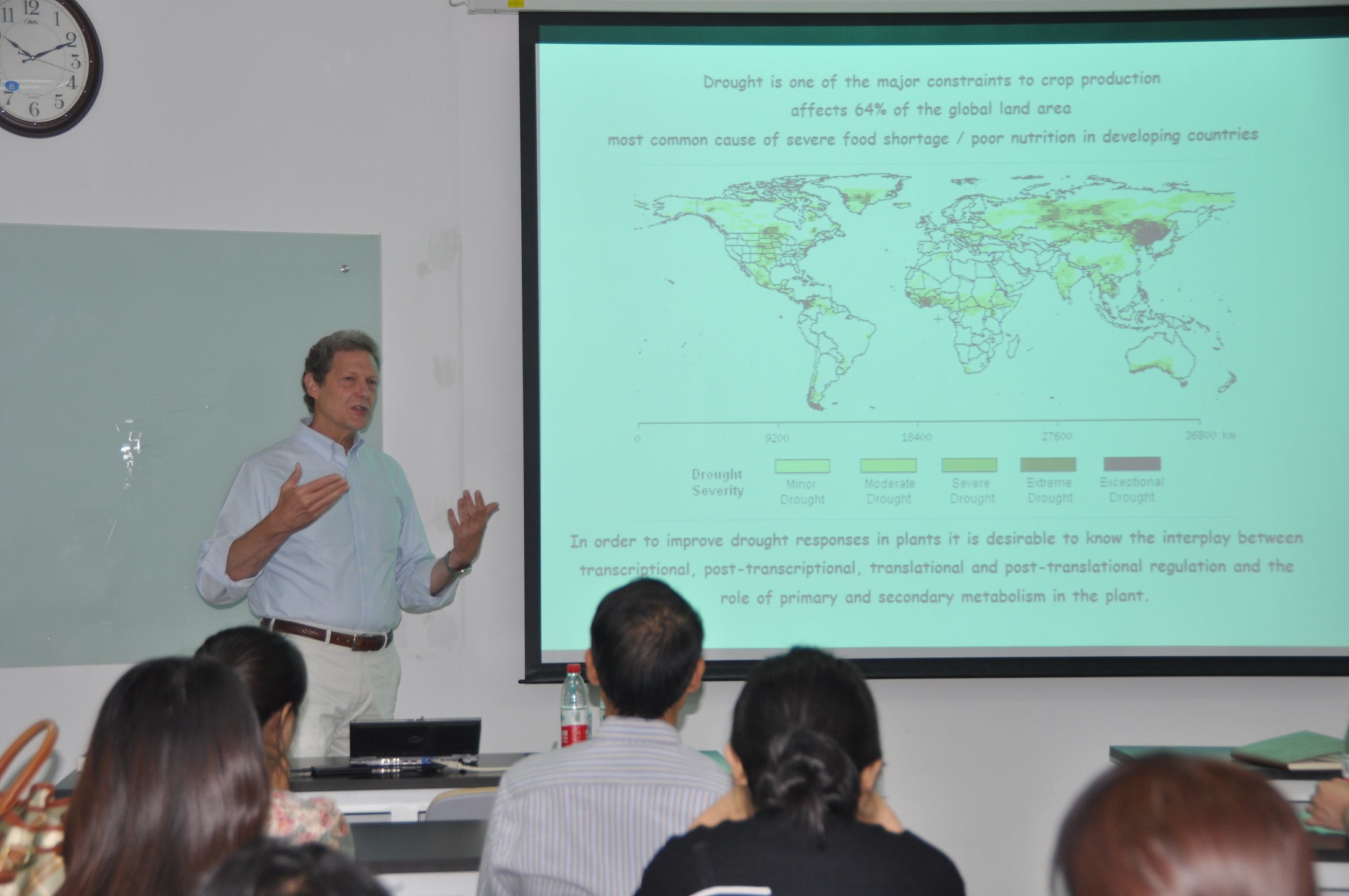
2015年6月15日,美國(guó)弗吉尼亞大學(xué)Mike Timko教授來我校開展北京大學(xué)現(xiàn)代農(nóng)業(yè)系列講座,本次的主題為Uncovering New Gene Targets Regulating Secondary Metabolism and Stress Responses in Plants.
Mike Timko教授在本次現(xiàn)代農(nóng)業(yè)系列講座上為北大師生系統(tǒng)闡釋了Striga。Striga,commonly known as witchweed, is a genus of parasitic plants that occur naturally in parts of Africa, Asia, and Australia. Some species are serious pathogens of crop cereals, causing considerable crop losses with the greatest effects being in savanna agriculture in Africa. Research in Dr. Timko’s lab is conducted at the cellular and organismal level using a wide range of biochemical, molecular, and genomic approaches to understand the molecular components and signaling pathways that govern the interaction of Striga with their host species. Through comparative functional genomics, host defense components and parasite virulence effectors underlying compatible and incompatible host-parasite association have been identified. These studies also included an examination of the evolution of parasitism in the Orobanchaceae as a way of determining what makes parasitism in angiosperms an attractive life-history option and the implications in managing Striga as pathogens.
Mike Timko教授還與李磊教授實(shí)驗(yàn)室進(jìn)行了學(xué)術(shù)交流。